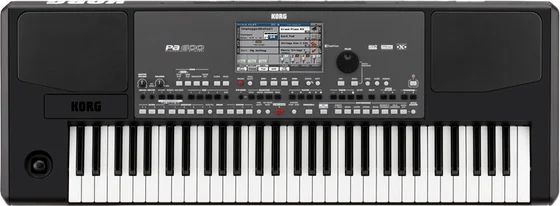
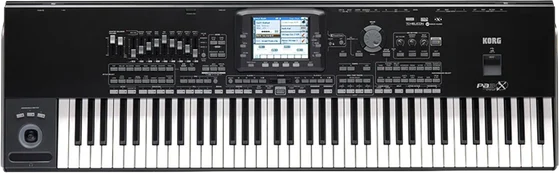
Arrangium converts a Pa600 SET into a Pa3X SET. This direction was measured at file level on real SETs. Below you can see what happens to each type of content in this direction.
The file layouts of the two models. Rows that differ are marked: that is where the conversion does its work.
DIFFERENT · 3 / 12
Pa600Pa3X
Style object.STY v0.5.STY v0.5
STSSTS v1.0STS v1.0
Number of Fills44
Ending 3✓✓
PerformancePERFORMANCEPERFORMANCE
Sound (PCG)PCG v3.0PCG v3.0
Sample (PCM)PCM v0.0PCM v0.0
Multisample (KMP)KMP v3.0KMP v3.0
Voice Preset—VOC v2
Compressed samples—✓
Sample RAM96 MB256 MB
Chord Sequence——
IN THIS DIRECTION
Pa600 → Pa3X: what carries over, what changes?
Each card is one content type. The rules are read from the app’s code.
STYLECARRIED
StylesStyleThe accompaniment: Intro, Variation, Fill, Break and Ending elements, each with Drum, Percussion, Bass and ACC1–ACC5 tracks. Not only a drum pattern.Stored in: .STY · .stg are read as they are
The target’s Style limit is equal to or higher than the source’s: the Style is read as it is and written in the Pa3X layout.
SOUNDCARRIED
SoundsSoundA playable program built from one or more oscillators (multisamples) with filter, envelope and effect settings. Styles, the keyboard and pads call it by bank and number.Stored in: .PCG are written in the PCG v3.0 layout
Sounds are written from the PCG v3.0 layout to the PCG v3.0 layout. Factory Sounds are remapped by name or by address.
SAMPLECARRIED
Samples carry over
User samples and multisamples are written in the Pa3X SET’s layout; the sample itself does not change.
RAMCARRIED
More RAM in the target: 96 MB → 256 MB
The SET fits the target easily, with room to spare.
PERFORMANCECARRIED
PerformancesPerformanceOn the Pa3X and earlier generations, stores the keyboard sounds and settings. The Pa4X generation and the Pa5X use the Keyboard Set for this; the two are not identical.Stored in: .PRF carry over
Both models use PERFORMANCE; Performances are written in the target’s version.
VOICE PRESETNOT IN SOURCE
No Voice Presets in the source
Pa600 SETs have no Voice Preset bank.
SONGBOOKADAPTED
SongBook carries over
Set Migrator moves the SongBook to the Pa3X SET: if its versions are ones also seen in Pa3X SETs, it copies them as they are; if not, it rewrites the songs with the Pa3X template. Set Lists carry over only if they are in a version Pa3X reads.
QUARTER TONECARRIED
Quarter-tone presets carry over
Both models carry quarter-tone presets.
GLOBALADAPTED
GlobalGlobalThe instrument's general settings: master tune, scale, velocity curve, transpose, split point, language.Stored in: .GBL settings are adapted
Set Migrator takes the Pa3X factory GLOBAL as its base and writes these from the Pa600 SET: master tuning, scale, key, style group levels, velocity curve and MIDI presets. My Setting, bank names and language stay at the Pa3X factory values.
DETAILED TABLE
Pa600 → Pa3X, row by row.
SOURCE
CONVERSION
TARGET
Pa600Pa3X
What Pa5X KST content becomes in a Pa4X SET
Pa600
CONVERSION
Pa3X
.STYSTYLE.STY v0.5
CONVERTED
.STYSTYLE.STY v0.5
the Pa3X reads it as it is
Drum · Perc · Bass · Acc1–Acc5
CONVERTED
Drum · Perc · Bass · Acc1–Acc5
Intro 1–3
CONVERTED
Intro 1–3
Variation 1–4
CONVERTED
Variation 1–4
Fill 1–4
CONVERTED
Fill 1–4
Break
CONVERTED
Break
Ending 1–3
CONVERTED
Ending 1–3
STS 1–4v1.0
CONVERTED
STS 1–4v1.0
Pad 1–4
CONVERTED
Pad 1–4
Master FX · StyleFX A1–A2
CONVERTED
Master FX · StyleA-Master 1–3
Master FX · STSFX B1–B2
CONVERTED
Master FX · STSB-Master 1–3
Insert FX
NOT IN SOURCE
—the Pa600 does not save it
EQTrimLowMidHigh
CONVERTED
EQTrimLowMidHigh
.PRFPERFORMANCEPERFORM/*.PRF
ADAPTED
.PRFPERFORMANCEPERFORM/*.PRF
Performance objectPERFORM/*.PRF
CONVERTED
Performance objectPERFORM/*.PRF
Sound
ADAPTED
Sound
user sounds travel along; to a free slot when the address is taken
.PADPAD
LIMITED
.PADPAD
only the style’s pad number and mixer are written
.PCGSOUNDSPCG v3.0
ADAPTED
.PCGSOUNDSPCG v3.0
version kept, ROM numbers translated
The sound object keeps its version; the Pa3X reads it
ROM numbers are translated by name
Factory sounds are matched to Pa3X factory sounds by name. A sound in the GM bank stays in the GM bank, at its own number. A sound with no counterpart by name is pointed at the nearest sound of the same kind (first the same program number, then the same GM family), and this is reported
OscillatorMultisampleVelocity
ADAPTED
OscillatorMultisampleVelocity
ROM multisamples matched by name
PitchBendPortamentoAMS
CONVERTED
PitchBendPortamentoAMS
Filter
CONVERTED
Filter
Amp
CONVERTED
Amp
EGPitchFilterAmp
CONVERTED
EGPitchFilterAmp
LFO
CONVERTED
LFO
FXFX 1–2
CONVERTED
FXFX 1–2
.PCGDRUM KIT · UserPCG v3.0
ADAPTED
.PCGDRUM KIT · UserPCG v3.0
Keys0–127
CONVERTED
Keys0–127
LayersVelocity Switch
CONVERTED
LayersVelocity Switch
Drum sample
ADAPTED
Drum sample
factory sample by name; a user sample travels with the kit
PitchTransposeTune
CONVERTED
PitchTransposeTune
AmpLevelAttackDecay
CONVERTED
AmpLevelAttackDecay
FilterCutoffResonance
CONVERTED
FilterCutoffResonance
EQ
CONVERTED
EQ
.KMPMULTISAMPLEKMP v3.0
ADAPTED
.KMPMULTISAMPLEKMP v3.0
KeymapZoneTop KeyOriginal Key
ADAPTED
KeymapZoneTop KeyOriginal Key
rebuilt in the Pa3X version
Sample linkID
ADAPTED
Sample linkID
linked by id
.PCMSAMPLEPCM v0.0
CONVERTED
.PCMSAMPLEPCM v0.0may be compressed
AudioSample rate
CONVERTED
AudioSample rate
no resampling
The sample rate travels as it is; nothing is resampled
Loop · One Shot
CONVERTED
Loop · One Shot
.VOCVOICE PRESET
NOT IN SOURCE
.VOCVOICE PRESETVOC v2
.SBDSONGBOOK
ADAPTED
.SBDSONGBOOK
In Set Migrator; songs whose version does not match are rewritten with the Pa3X template
Songs, their Style links and Set Lists are written to the Pa3X SongBook
A SongBook whose versions are also seen in Pa3X sets is copied as is; only each song’s Style link is pointed to its new location
Songs whose version does not match are rewritten with that model’s template song on Pa3X, Pa4X, Pa1000 and Pa700; on other targets the SongBook is not carried at all, and the report says so
Set Lists are carried only if they are in a version Pa3X reads; if the target already has a SongBook, it is left untouched
.QTPQUARTER TONEGLOBAL/QTPRESET.QTP
ADAPTED
.QTPQUARTER TONEGLOBAL/QTPRESET.QTP
named presets
Only presets that were given a name travel; on the target they go to slots still under a default name (“Scale n” / “QTPreset n”)
Set Migrator carries the whole set; Set Commander does it preset by preset on the SCALES tab (APPLY, UNDO)
If the target SET has no quarter-tone file, nothing is carried and the report says so
CHORD SEQUENCE
NOT IN SOURCE
—the Pa600 does not save it
.GBLGLOBALSETUP.GBL
ADAPTED
.GBLGLOBALSETUP.GBL
In Set Migrator, on top of the Pa3X factory GLOBAL
The Pa3X factory GLOBAL files are the body; the Pa600 file is not copied
Master Tuning
CONVERTED
Master Tuning
Scale · Key
CONVERTED
Scale · Key
Style group levels
CONVERTED
Style group levels
Velocity curve
ADAPTED
Velocity curve
same number; the curve tables differ
MIDI presets
CONVERTED
MIDI presets
Other Global pagesMy SettingMIDILanguage
NOT CONVERTED
—stay at the Pa3X factory values
RAMPa60096 MBPa3X256 MBSet Migrator fits it and reports what does not fit
What if it does not fit? Explore the optimisation.
SMART RAM OPTIMISATION
Keeps first. Optimises when it must.
Set Migrator compares the sample memory the selected content needs with the target instrument’s capacity. If it fits, samples are written as they are. If it does not, it offers sample compression, multisample thinning and leaving out unused multisamples, each with its estimated effect; the choice is yours.
Keep what fits. Optimise what does not, under your control.
1 · ANALYSE
Capacity analysis
Unique samples are counted once and compared with the target’s sample memory and sample-count limit. When a kit travels with only its struck keys, only those keys count.
EXAMPLE SCENARIO · NOT A MEASUREMENT
Example conversion result
FITS AS IT IS
Memory needed
58 MB
Target capacity
256 MB
Left free
198 MB
target 256 MB
22% of capacity
The example SET’s sample memory fits the target instrument. No RAM optimisation is needed. This covers memory only; format and content compatibility are checked separately.
Example need: 60% of the source capacity (illustrative)
Drum Kit usage analysisOptional · chosen per kitThe styles’ note data tells which keys of a kit are really struck. A kit can travel with all its keys or with only the keys those styles strike; the choice is made per kit, and nothing is deleted from the source SET.
If even one selected style could not be measured, the kit travels whole.
A kit a Performance plays, or one picked on its own, travels whole.
By default a kit travels whole. Only the struck keys are chosen per kit: with KEYS on the kit’s row in Set Migrator, and per kit in Set Commander. The memory count follows the choice.
2 · DECIDE
Does it fit the target?
✓ FITSIf it fits, nothing is touched
The default answer is “keep as is”: no compression, no thinning, nothing that changes the sound.
KEEP AS IS
✕ DOES NOT FITIf it does not fit, you decide the method
When the target capacity is exceeded you can choose automatic optimisation or pick the operations by hand. Either way the results are shown for review before anything is written.
↓ 3 · METHOD
3 · METHOD
Choose the optimisation method
Automatic optimisation
OPTIMIZE FOR SIZE: compression (where the target supports it), zone thinning and leaving out unused multisamples together. Each step and its possible effect on quality is shown in REVIEW; nothing is written before you approve.
Manual optimisation
Choose compression only or zone thinning only; on the CONTENT page thinning is marked for each Sound, Kit or Multisample. The changes are reviewed before anything is written.
4 · REVIEW
REVIEW: see the estimated result
In both modes the REVIEW step shows the estimated result and waits for your approval before anything is written. The estimate is an upper bound, not a promise.
5 · WRITE
Written on your approval, then checked
The converted SET is written after you approve and read back in the VALIDATE step. If the target is still over, it says so; the styles that do not fit are left for another set.
CONVERTED: same structure · ADAPTED: rebuilt in the target structure · LIMITED: part is dropped or a condition applies · NOT CONVERTED: no converter for this direction
PROOF
How was this direction tested?
Set Migrator’s matrix check runs this direction on real SETs: the SET is converted, read back from disk and validated. Cases that do not fit the target are rolled back by design.
MEASUREDIN CODE · NOT MEASUREDLIMITEDNOT SUPPORTED
FREQUENTLY ASKED QUESTIONS
Questions about Pa600 → Pa3X
Yes. The Pa600 → Pa3X direction was converted at file level on real SETs and read back. If a SET does not fit the target, the job is rolled back and the reason is stated.
User samples and multisamples are written in the Pa3X SET’s layout; the sample itself does not change.
No content type is dropped in this direction.
Move your Pa600 SET to a Pa3X SET.
Arrangium is not on sale yet. Leave your email on the home page and we will tell you when it launches.